



Coat of Arms - Ordinaries
An ordinary is considered to be a charge, or bearing, of simple form.
The ordinaries, or as they are called by the majority of heraldic writers, honorable ordinaries, are thought to be nine in number as follows:
Chief, Cross, Pale, Saltire, Fesse, Pile, Chevron, Quarter, and Bend.
.
|
BEND |
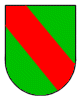
The BEND is drawn typically covering 1/5th of the shield running from the upper right corner down to the lower left of the base. If the portion of the shield that the BEND covers also contains a bearing, or charge, it may cover 1/3rd of the surface.
Stands for Defense or Protection. |
|
BEND SINISTER |
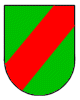
The BEND SINISTER covers the same area of the shield, but is run from the upper left corner down to the lower right of the base.
Marks Royal descent that is barred from succession to the throne by illegitimacy. |
|
CHEVRON |
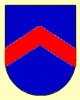
The CHEVRON represents the roof of a house, derived from the French word 'chevron' meaning rafter. The CHEVRON used to almost reach the very top of the shield and then more nearly attained the 1/3 of the surface of the shield that was allotted to it by the guidelines of heraldry. Now it is drawn lower and with a less acute inner angle to allow more devices to be represented more attractively, and an artist may draw the chevron at the height and angle that will best suit the accompanying charges.
Stands for Protection. |
|
CHIEF |
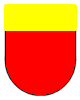
The CHIEF is a broad band across the top of the shield that stands for authority and domination of will. The CHIEF theoretically contains the upper 1/3 of the shield, although it rarely actually does.
Stands for Dominion and Authority. |
|
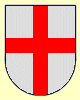
CROSS |
One of the earliest and noblest of the honorable ordinaries. The CROSS is drawn with two bars which run horizontally and vertically across the center of the shield with each bar being 1/5th the width of the shield. There are a large variety of crosses which may be found in heraldry and we will display the majority of them ones on the crosses page
Stands for Protection |
|
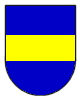
FESSE |
A bar placed horizontally across the shield, occupying one-third of the shield. This bar may have charges placed on it and typically divides the shield into thirds.
It represents a Military Belt or girdle of Honor. |
|
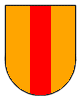
PALE |
A bar placed vertically down the center of the shield, occupying one-third of the field. This bar may have charges placed on it and typically divides the shield into thirds.
Stands for military strength or fortitude. |
|
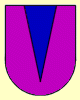
PILE |
The PILE is a wedge shaped section with the wide portion at the top of the shield and running to the bottom center point of the shield. When this is drawn plain it is generally 1/5th the width of the shield at the top, when it has charges it is then typically 1/3rd the width of the shield at the top.
Stands for military strength or fortitude. |
|
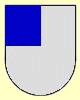
QUARTER |
The QUARTER is a field covering 1/4th of the shield. It is normally placed to cover the upper right hand portion of the shield and if placed in any other position it must be specified in the blazon.
It is a bearing of Honor. |
|
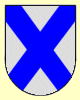
SALTIRE |
The SALTIRE is a combination of the BEND and the BEND SINISTER in the form of an X. It is sometimes referred to as a St. Andrew's Cross.
Most frequently stands for protection. |