



Coat of Arms - Charges T-Z
Charges | A | B | C | D - F | G - H | I - N | O - Q | R - S | T - Z |
|
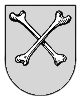
Thigh Bones |
Denotes mortality. |
|
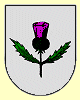
Thistle |
The thistle is an ancient heraldic emblem of pain and suffering. It is the royal badge of Scotland. |
|
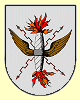
Thunderbolt |
The thunderbolt is an ancient heraldic emblem of sovereignty, power and speed. It is derived from the classic mythology in which the thunderbolt is the symbol of the Roman god Jupiter, or the Greek god Zeus. See also LIGHTNING BOLT. |
|
Tiger/Tyger |
The tiger signifies great fierceness and valor, and dangerous when enraged to combat. It also symbolizes one whose resentment will be dangerous if aroused. The tiger depicted in heraldry was the attempt of artists to portray an animal they had never seen and knew only by repute. Consequently, the heraldic tiger had the body of a wolf with a lion's tail and a mane, powerful jaws, and a long, pointed snout. It was referred to as a tyger to differentiate it from a regular tiger. A regular tiger was referred to as a Bengal tiger.
The tyger is sometimes shown staring into a mirror. This is based on the legend that the female tyger is a fierce and protective mother but has the fault of being easily hypnotized by her own reflection, thus allowing her children to be stolen by anyone holding a mirror. |
|
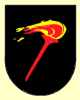
Torch |
The torch or firebrand signifies life, truth, intelligence, knowledge, purification and love. The bearing of a torch in arms is granted to a zealous man who has performed some signal service. |
|
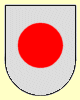
Torteau |
A torteau is the name given to a red roundle, a roundle being any circular charge of color or metal. It represents the communion wafer or the cakes of bread eaten by crusaders before long battles. |
|
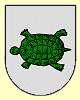
Tortoise |
The tortoise signifies invulnerability to attack and is also symbolic of slow, but sure progress. |
|
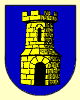
Tower |
The tower is very similar to a castle in that it was often granted to one who had faithfully held a castle for his sovereign, or who had captured one by force or stratagem. It is an emblem of grandeur and society. It is also a symbol of defense and of a steadfast individual. See also CASTLE. |
|
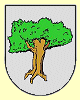
Tree |
The tree is a symbol of antiquity and strength. The oak tree was sacred to the ancient Greeks and the Celts; the lime or linden tree was sacred to the Germans and the ash tree was sacred to the Scandinavians. Trees symbolize home or property, and they are also generally considered a symbol of life and strength. |
|
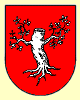
Tree Trunk |
A tree stump or tree trunk with sprouting leaves may be used as a symbol of regrowth and rebirth. It is an object of veneration. |
|
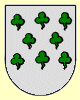
Trefoil |
A trefoil, or a symbol of a three-leafed clover also known as a shamrock, represents the past, present and future. It is also often used as a symbol of fertility and abundance. According to legend, the shamrock was chosen as an emblem of Ireland because it was used by St. Patrick to explain the Holy Trinity. The shamrock also appears on some arms. See also SHAMROCK. |
|
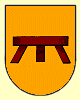
Tressle |
Symbolizes hospitality. |
|
Tressure |
A tressure is two small borders in the outline of a shield, set close together, one within the other. The tressure symbolizes preservation or protection. |
|
Tressure-Flory-Counterflory |
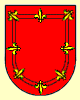
If the tressure is decorated with flowers that look somewhat like the fleur de lis, inserted through the tressure it is known as a tressure-flory-counterflory. This is particularly associated with Scottish heraldry as it represents the close and long term alliance between France and Scotland. |
|
Trident |
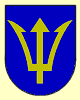
Dominion over the seas. |
|
Trumpet |
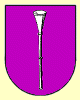
Ready for the fray. |
|
Unicorn |
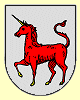
The unicorn is a mythical creature that has always been known as a symbol of purity and virtue. Thus it is sometimes used as a symbol of Christ. According to legend, the unicorn's horn has the power to heal sickness and purify water. Supposedly the unicorn could only be captured and tamed by a virgin. It would sense her purity and lay its head in her lap.
The heraldic unicorn is drawn with the body of a horse, the tail of a heraldic lion and the legs and feet of a deer. It is a popular symbol in heraldry; sometimes the head alone is also found. |
|
Vulture |
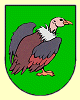
The vulture symbolizes death to ones enemies. |
|
Water Bouget |
Indicates one who carried water to the arms or to a besieged place. See also BOUGET. |
|
Weapons |
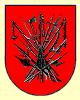
Symbolizes one who is greatly skilled in battle. |
|
Weasel |
The weasel, stoat, martin, and the ermine are all very similar animals that can be found occasionally as heraldic symbols. The ermine symbolizes purity. This association comes from the legend that this small white animal preferred death to defilement. The martin is the vanguard of spring and represents one who brings good news. |
|
Whale |
According to legend, the whale was often mistaken for an island. Ships that anchored to its side were dragged down to destruction by a sudden plunge of the immense creature. In this way, the whale came to be used as a symbol of the Devil, and the whale's open mouth the open gates of hell. |
|
Wheat Ear |
Symbolize faithfulness. |
|
Wheat Sheaf |
The garb or wheat-sheaf, signifies plenty and commendable hospitality in the bearer. It may also mean that the harvest of the bearer's hopes is secured. |
|
Wheel |
In the heraldic tradition, the wheel is used as an emblem of fortune and the cycle of life. See also CATHERINE WHEEL. |
|
Wings |
Symbolizes swiftness and protection. |
|
Wolf |
The crest of a wolf has been granted to valiant captains who served loyally through long sieges or hard enterprises. It signifies valor and guardianship. Wolves were viewed as ferocious and merciless and it was thought that they could paralyze their enemies with a look before destroying them. The bearer of this symbol was one who was dangerous to assail or thwart and a deadly enemy to have.
The head of a wolf is particularly common in Scottish heraldry. |
|
Woodbill |
The wood-bill is an instrument used by woodsmen for cutting down trees. As a charge it is often used to represent an instrument of war and one who is prepared to use it. |
|
Woodbine |
More recently known as honeysuckle, it represents love that does not injure that which it clings to. |
|
Wreath |
They are symbolic of triumph and fame, especially when it is gained after a long, inner struggle. Sprigs of laurel and laurel branches are also common heraldic symbols. See also LAUREL WREATH. |
|
Wyvern |
The wyvern or wivern is a mythical beast with the upper part of a dragon, two legs and a body that curves into the tail of a serpent. It symbolizes valor and protection. Also, the wyvern was supposed to have a keen sense of sight, which enabled it to guard treasures. The bearer of this symbol may have been a keen defender, or was thought to have slain a wyvern. It is also a symbol of vengeance or perseverance. |
|
Yale |
The yale is a mythical creature about the size of a horse with the face of a lion, the tusks of a boar, a goat-like body, and extremely long, goat-like horns which it could move in any direction to meet attacks. It also has a mane, a tufted spine, a tufted tail, and cloven hooves. It is a symbol of preparedness and readiness. |
|
Yarn Fusil |
Symbolizes negotiation. See also FUSIL. |