




Marks of Cadency for a Coat of Arms
First through the Sixth
Just as the original intent of a Coat of Arms was to distinguish one knight from another (since they were in armor with a helm protecting and also hiding their features), it was also necessary to provide distinctive bearings for different members of a family all entitled to bear the paternal arms. This gave rise to the use of Marks of Cadency, or differences (called by the French brisure).
The eldest son (during the lifetime of his father) bears a label of three points; the second son, a crescent; the third, a mullet; the fourth, a martlet; the fifth, an annulet; and the sixth, a fleur-de-lis. Some historical documentation carries that out to the tenth, with the seventh bearing a rose, the eigth a cross moline, the ninth an anchor, and the tenth a double quatrefoil.
The graphics below show each of the Marks of Cadency, along with examples of how an original Coat of Arms might look with the different Marks applied.

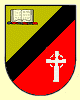 |
Original Coat of Arms |
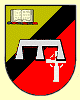 |
First Son |
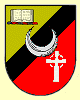 |
Second Son |
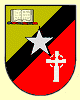 |
Third Son |
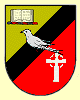 |
Fourth Son |
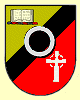 |
Fifth Son |
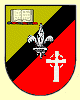 |
Sixth Son |