



Coat of Arms - Crosses
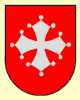
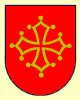
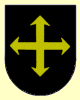
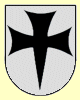
The armorial sign of the cross is unique in Christendom. It is the first common sign under which the West gathered. The cross became an established standard after Constantine's victory over Mantius in A.D. 312. The use of the cross on arms belong to the time of the first crusades, in which the principal nations of Christendom are said to have been distinguished by crosses of different colors. It is also naturally found to be most frequently employed in the insignia of religious foundations. The fact that the Crusaders embarked on the western coast of the Mediterranean is marked by the presence of the cross in many of the Coats of Arms which are found there.
|
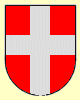
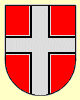
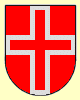
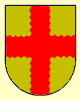
Christian Cross |
Faith; service in the Crusades. Also known as the cross of St. George, it is one of the earliest crosses. It is sometimes referred to as a Greek Cross. |
|
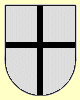
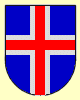
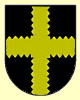
Cross Fillet |
Represents achievement in battle. Also dominion and authority. |
|
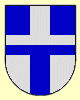
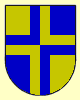
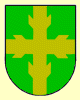
Cross per Fess |
Represents readiness to serve the public. Tinctures chosen give additional meanings. |
|
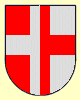
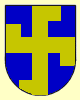
Cross per Pale |
Signifies defensive military strength. The tinctures chosen give additional meanings. |
|
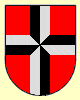
Cross Quartered |
Represents readiness to fight for Christianity. Tinctures chosen give additional meanings. |
|
Cross Gyronny |
Represents readiness to fight for Christianity. Tinctures chosen give additional meanings. |
|
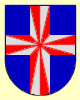
Cross Gyronny of Sixteen |
Represents unity. The tinctures chosen give additional meanings. |
|
Cross Faceted |
Represents the many facets of Christianity. |
|
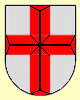
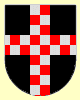
Cross Counter-Compony |
Also described as Chequy. It symbolizes intellectual challenge. It is a frequent sign used on small inns. It is possible that this design gave the name to the game of chess. |
|
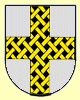
Cross Fretty |
Represents persuasion - as of the Christian message. |
|
Cross Double Voided |
Represents a knight of the Crusades. The tinctures chosen give additional meanings. |
|
Cross Cotised |
Designed to represent the suspender of a knight, signifying defense or protection. Tinctures chosen give additional meanings. |
|
Cross Fimbriated |
Most common in French arms. Represents one who faithfully served in the crusades. Most often found in ancient blazoning. The tinctures chosen give additional meaning. |
|
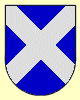
Saltire or St. Andrew's Cross |
Symbolizes resolution and persuasion. Most often found on Scottish Arms. |
|
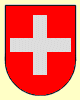
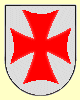
Cross Couped |
Faith, service in the Crusades. The white cross on the red ground was the symbol of the Holy Kingdom. Other countries adopted this symbol as evidence of their missionary zeal. The Order of the Knights Templar adopted the red cross on a white cloak as their symbol. |
|
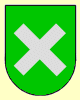
Cross Saltire Couped |
A form of St. Andrew's Cross. Symbolizes resolution and persuasion. |
|
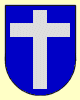
Passion Cross |
This is the basic Christian Cross. It is a long cross or Latin cross, meaning that is with the lower limb longer than the other three. Represents the passion of Christ. |
|
Passion Cross (2) |
Passion Cross with both cross bars the same length. Meaning is same as Passion Cross. |
|
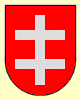
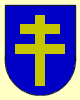
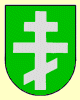
Patriarchal Cross |
An ancient cross which has two horizontal bars instead of one. It is so named because it represents the ancient Patriarchs of Jerusalem that bore this kind of cross. After the Crusades it was borne by the Patriarch of Constantinople. |
|
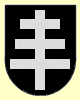
Patriarchal Cross with Third Bar |
Cross adopted by the Pope of Rome. Symbolizes the Church. |
|
Russian Cross |
Meaning is similar to the Patriarchal Cross with third bar. The symbol was adopted and modified by Knightly Orders in Russia. |
|
Cross Formy |
Represents military honor. One example is found as early as Henry III. |
|
Cross Pattee Concave |
Sign of a military leader who has accomplished great deeds. It is also said to be used as a mark of cadency in France. |
|
Cross Formy Couped |
Military honor. |
|
Cross Potent |
The Cross Potent, written sometimes potence (fr. potencée): so called because its arms terminate in potents, or like crutches. Similar to the Jerusalem Cross, it symbolizes the five wounds of Christ. |
|
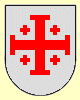
Jerusalem Cross |
So named from its occurrence in the insignia of the kingdom of Jerusalem, established by the Crusaders. The crosses are believed to symbolize the five wounds of Christ. |
|
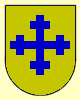
Cross Crosslet |
Signifies the fourfold mystery of the Cross. May also refer to families who engaged in the Crusades. |
|
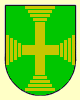
Cross Degraded |
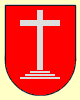
This is the Cross of Calvary with the steps or degrees on each end of the cross. The number of steps is often four, and sometimes as many as eight. It represents Christianity, and faith in the mystery of the Cross. |
|
Cross Calvary |
Cross Calvary (also known as the Holy Cross and sometimes referred to as a Latin Cross) symbolizes faith and Christianity. It is said that the three steps are symbolic of the three Christian graces: Faith, Hope and Charity. Some writers have suggested that the bearer took the arms in consequence of having erected such a cross at Rome. |
|
Cross Moline |
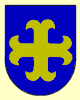
Signifies the mutual converse of human society. It is said to represent a millstone or a fer-de-moline. It is sometimes a mark of cadence representing the eighth son. It is also known as a Miller's Cross. |
|
Cross Recercely |
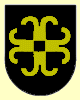
A cross where the ends have been "voided." It is believed to represent one who was injured in battle. |
|
Cross Moline Quarter-Pierced |
The mutual converse of human society (said to represent a millstone). |
|
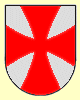
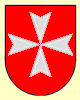
Cross Maltese |
Represents blessings; A cross of this form is the badge of Knight's Hospitalier and the badge of the knights of Malta, and of some other religious orders. The points are imagined to symbolize the eight beatitudes. Also found as the symbol for the Order of St. Stephen. If the cross is in white, it may represent the Military Order of Maria Theresa. |
|
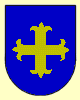
Cross Flory or Fleuretty |
A cross flowered at each end. Represents one who has conquered. The flowers signify purity and innocence. |
|
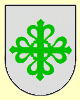
Cross of any Iberian Order of Knighthood |
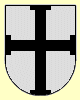
Three particular Orders of note are (1) the Order of the Knights of St. John - began at a hospital and took care of Crusade pilgrims. (2) Teutonic Order - which admitted only knights from countries belonging to Germany. (3) Order of the Knights Templar - mainly French knights, adopted this cross in the early years when they were extremely poor. Later they became very wealthy and powerful and changed their symbol to the Cross Couped. The Templars were abolished by the King of France, but some of the other Orders still exist. |
|
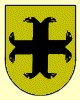
Cross Gringoly |
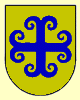
This cross is used only in French heraldry. It is a cross with the heads of snakes issuing from the ends. It is said to signify the ability to devour those who attack the cross. |
|
Cross Fourchy |
It is found in ancient blazon, particularly in the time of Henry III. It is believed to represent the cross of a miller. |
|
Cross Fitchee |
A combination of cross and sword; unshakeable faith. |
|
Cross Bottony |
Symbolizes the past and the future of the gospel of Christianity. Generally found on French arms. The name is derived from the French bouton, a bud or knob. It is a cross ending in three lobes like the trefoil leaf, and occurs rather frequently. |
|
Cross Pommy |
A plain cross terminating in four round pommels - like the knob at the end of swordhilts or the knobs at the top of the pilgrims' staves. It represents the supremacy of Christianity and the valiant knight who fights for it. |
|
"Key" Cross |
Also known as Cross Clechee. It is similar to the Cross Toulouse which is the insignia of that city. It is assumed that the bearer of either of these crosses was a crusader from the area of Toulouse. |
|
Cross Toulouse |
Appears in the insignia of the city of Toulouse. Suggests a crusader from that area. |
|
Cross Barby |
The ends of the cross represent hooks and may symbolize military duty at sea. |
|
Cross Formy Fitchee Couped |
A combination of cross and sword; unshakeable faith. |
|
Cross Fitchee Double Couped |
A combination of cross and sword; unshakeable faith. |
|
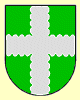
Cross Indented |
Represents fire. May represent holy fire in battle. |
|
Cross Engrailed |
The symbol of land or earth. May represent a crusader who sought to take Christianity throughout the earth. |
|
Cross Invected |
The symbol of land or earth. May represent a crusader who sought to take Christianity throughout the earth. |
|
Cross Bretessed |
A form of the Engrailed cross. The symbol of land or earth. May represent a crusader who sought to take Christianity throughout the earth. |
|
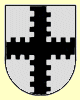
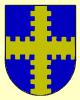
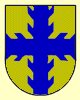
Cross Embattled / Counter Embattled |
Represents Holy assault against the walls of a town. |
|
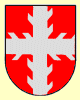
Cross Raguly |
Difficulties encountered, perhaps in the name of Christianity. |
|
Cross Raguly Counter Raguly |
Difficulties encountered, perhaps in the name of Christianity. |
|
Cross Raguly and Trunked |
Difficulties encountered, perhaps in the name of Christianity. |
|
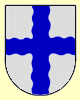
Cross Wavy |
Represents the mystery of the cross. |
|
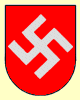
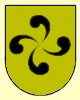
Swastika Couped in Saltire |
Swastika is the Sanskrit word for Fylfot. It is a symbol of felicity. |
|
Fylfot |
Once considered as a good luck charm. |
|
Fylfot Clubbed |
Good luck charm. |
|
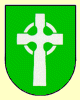
Cross Celtic |
Unity of heaven and earth. |
|
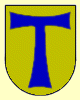
Tau Cross or Cross of St. Anthony |
St Anthony is represented with such a cross embroidered upon the left side of his garment. It is said to represent a token of absolution with which the depraved are said to have been stamped on the hand. It should be drawn like a Greek Tau. |
|
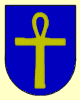
Egyptian Cross |
Also known as the Ankh. It is believed to symbolize life. |