



Coat of Arms - Charges O-Q
Charges | A | B | C | D - F | G - H | I - N | O - Q | R - S | T - Z |
|
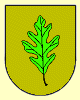
Oak Leaves |
Oak leaves are religious symbols of faith and endurance. They also symbolizes great age and strength. |
|
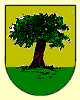
Oak Tree |
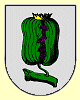
Symbolizes antiquity and strength. In Ireland the oak tree was the most noble of chieftain trees. |
|
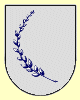
Olive Branch |
Represents peace and concordance. |
|
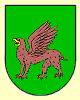
Opinicus |
This is a mythological animal that has a griffin's head, neck and wings, a lion's body and a bear's (or camel's according to some references) tail. It is believed to represent perseverance and valor. |
|
Orange |
An orange is the name given to a tawny roundle, a roundle being any circular charge of color or metal. It is said to represent a tennis ball. Tennis was once a game played strictly by royalty and nobles, thus indicating that the bearer was a member of that class. |
|
Orb |
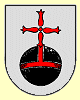
Also known as mound. Part of the monarch's regalia consisting of a ball surmounted by a cross, which symbolizes temporal sovereignty under the rule of Christ. |
|
Ostrich |
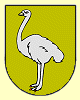
The image of an ostrich is symbolic of faith and contemplation. It also represents willing obedience and serenity. |
|
Otter |
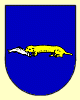
The image of an otter denotes that its bearer possesses industry and perseverance, as well as an ability to return to moments of play. It also represents one who lives life to the fullest. The otter is most often found as a symbol in Scottish and Irish coats of arms. |
|
Owl |
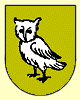
The owl symbolizes one who is vigilant and quick-witted. |
|
Ox |
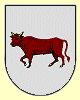
Signifies bravery, valour, and generosity. The horns represent strength and fortitude. See also BULL. |
|
Pale |
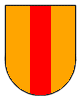
The pale is a vertical band down the shield denoting great defensive military strength and fortitude. It has often been bestowed on those who have defended cities, supported the government of their sovereign, or stood strong for their country under stress. |
|
Pall |
As a device on a crest, the pall represents the ecclesiastical vestment called a pallium and is symbolic of archiepiscopal authority. It is often found in the arms of archbishops. |
|
Palm Frond |
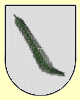
Symbolizes victory, justice, and royal honor. |
|
Palm Tree |
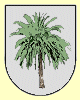
Symbolizes righteousness, resurrection, and victory. May also indicate that the bearer served or fought in a tropical country. |
|
Panther |
The panther is said to represent a beautiful woman who is tender and loving to her young, and will defend them even with her own life. It is a symbol of bravery in defense of the weak. The heraldic panther has little resemblance to an actual panther. |
|
Parrot/Popinjay |
The parrot, or popinjay as it is termed in heraldry, may signify distinguished service in a tropical country. |
|
Paschal Lamb |
The symbol of faith, innocence, bravery, gentleness, purity, resolute spirit. It is commonly displayed with the lamb bearing a flag or banner. See also LAMB. |
|
Passion Nails |
Passion nails are borne as a reminder of poignant suffering that the first bearer of the arms underwent.
The symbol of 3 black passion nails piercing a red heart was borne on the shield of Sir R. Logan who accompanied James Douglas to Jerusalem with the heart of Robert the Bruce. |
|
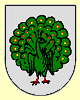
Peacock |
In ancient times, it was believed that the flesh of the peacock would not decay. It was therefore used as a symbol of resurrection and immortality. It also represents beauty, power, and knowledge. |
|
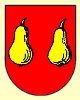
Pear |
Symbolizes felicity and peace. |
|
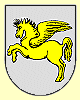
Pegasus |
Pegasus, the legendary winged horse from Greek mythology, is said to signify exceeding activity and energy of mind, whereby one may mount to honor. It is also a symbol of fame, eloquence, and contemplation. The Pegasus may also represent poetic genius and inspirations. Some believed it symbolized a messenger of God. |
|
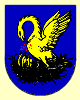
Pelican |
The female pelican was believed to wound her breast with her long, curved bill, drawing blood to feed her young. For this noble act, the bird became a symbol of piety, self-sacrifice, and virtue. It also symbolizes the duties of a parent or parental love. |
|
Pellet |
A black roundle is given the various names of pellet, ogress and gunstone, a roundle being any circular charge of color or metal. Black roundles represent cannon balls and bullets and may indicate that the first bearer was an artilleryman, or that he braved the dangers of cannon balls or bullets in battle. |
|
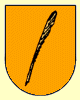
Pens |
Emblematic of the liberal art of writing and of learned employment. |
|
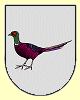
Pheasant |
Suggests an individual of many resources. |
|
Pheon |
The pheon is a cleverly designed arrowhead of ancient origin. It was particularly dangerous because it has a barbed inner edge that makes extraction difficult. It symbolizes dexterity and nimbleness of wit, as people with these traits are thought to be able to penetrate and understand complicated problems. See also SPEAR POINTS and ARROWS. |
|
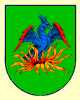
Phoenix |
The phoenix is a symbol from Greek mythology representing immortality, resurrection and renewal. Legend states that it would live for 5 centuries. At the end of its long life, this legendary bird built a pyre of spice-wood in the desert. It ignited the pyre by fanning its wings in the heat of the sun, plunged into the fire and was burned to ashes. Three days later a rejuvenated phoenix rose out of the cinders, born again. The phoenix is also a symbol of love. |
|
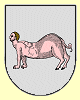
Pigman |
Rarely found in Heraldry. Meaning unknown. |
|
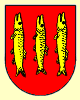
Pike |
The pike is a symbol for a military family and indicates prowess and fortitude in bearers of this charge. This fish is also a symbol of the forces of industry and science and early Christians frequently used the pike as an emblem of their faith. |
|
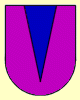
Pile |
The pile is a large piece of wood used by engineers in fortifications and bridge construction. The image of the pile was granted to military leaders for significant deeds, or to those who showed great ability in any kind of construction. In some instances it may represent a pennon or flag. |
|
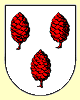
Pineapple |
Unless the arms described were granted in connection with a pineapple growing country, the term pineapple, in heraldry, actually refers to a pinecone. It is symbolic of the inexhaustible abundance of life in nature.
Occasionally real pineapples were granted as a symbol of distinguished service in a country where such fruit grew. |
|
Plate |
The plate is a white or silver roundle, a roundle being any circular charge of color or metal. It represents a silver coin found in Spain during the Crusades. The plate signifies generosity. |
|
Pomegranate |
The pomegranate is a symbol of fertility and abundance. The association is derived from the fact that the pomegranate is a fruit composed almost entirely of seeds and was thought to reproduce itself prodigiously because of this. |
|
Pomme |
Pomme or pomeis is the name given to a green roundle, a roundle being any circular charge of color or metal. The pomme represents an apple and signifies good luck. Most fruit was considered a token of good luck and symbolized the generosity of nature. |
|
Portcullis |
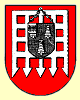
A portcullis is a great, barred, iron gate with spikes on the bottom, suspended over the main gate of a castle to be dropped before enemies could invade the castle. It signifies protection in an emergency, as it was used to guard the entrance to the fortress and could be suddenly lowered against a surprise attack. On a shield, a portcullis usually indicates that the bearer is a great defender in an emergency. It may also indicate that the original bearer operated the portcullis in a fort. |
|
Purse |
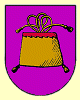
Denotes a frank and liberal steward of the blessings that God has bestowed. |
|
Python |
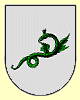
A python is a winged snake or serpent. It represents one who is swift to defend and meets out justice wisely. See also SNAKE and SERPENT. |
|
Quarter |
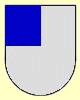
The quarter is a square in the right corner of the shield (or the left to the observer) that theoretically occupies 1/4 the shield's surface area, though it is usually slightly smaller than this. It is sometimes used as an augmentation of honor and it is also a mark used to distinguish the arms of one branch of a family from another, or that the name and arms of a family have been assumed where there is no blood descent. A canton in the left corner of the shield may be used as a mark of illegitimacy. |
|
Quatrefoil |
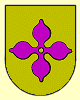
Quatrefoils have four leaves that are more circular and appear without the stem of a trefoil. The symbol of the quatrefoil was placed on churches to signify that the gospel, the harbinger of peace and immortality, was preached there. It was also the symbol of good tidings of spring.
The double quatrefoil signified the ninth son according to British rules of inheritance. |